Orchestration Reference Tool
Instrument ranges, playing techniques, and blend combinations — based on Rimsky-Korsakov’s Principles of Orchestration
Explore 38 orchestral instruments with detailed register guides, bowing and articulation techniques, and practical tips on which instruments work best together. Free and interactive.
Explore the Orchestra

Strings
The most expressive orchestral group. Capable of infinite shades from thundering fortissimo to barely perceptible pianissimo.

Woodwind
Diverse in colour and character. Bright instruments (flutes, clarinets) contrast with darker, nasal voices (oboes, bassoons).

Brass
The most powerful orchestral group. Heightens effect by sheer resonance, excellent for swelling from pianissimo to fortissimo.

Pitched Percussion
Instruments producing determinate sounds. Used for colour, punctuation, and sometimes melody. Timpani most important orchestrally.

Unpitched Percussion
Purely rhythmical and coloristic function. Use sparingly for maximum effect – triangle, snare drum, cymbals, bass drum, tam-tam.

Harp & Keyboard
Instruments of little sustaining power but distinct colour. Harp is primarily harmonic; piano and celesta add sparkle and clarity.
Why I Built This Tool
“Rimsky-Korsakov’s ‘Principles of Orchestration’ has sat on my piano since I was a student at the Royal Academy of Music. But physical books are awkward to reference mid-composition. I wanted something I could pull up instantly while working on a score.”
“This tool distils the practical wisdom from his 1913 masterwork into an interactive reference. Each instrument card shows you the range, register characteristics, and those golden tips that come from decades of orchestral experience.”
“Whether you’re scoring for film, opera and theatre, or choir with orchestra, I hope this helps you write more effectively for every instrument.”
About This Orchestration Reference
38 Instruments
Strings, woodwind, brass, percussion, harp & keyboard. Complete orchestral coverage with ranges and register characteristics for every instrument.
Techniques & Articulation
Bowing, tonguing, special effects for each instrument. Know what’s idiomatic and what to avoid before you write a note.
Blend Combinations
Which instruments pair well, doubling suggestions, and balance equations. Direct from Rimsky-Korsakov’s 1913 masterwork.
Orchestration for Beginners
Orchestration is the art of writing music for an orchestra, assigning instruments to different musical lines, and understanding how instrument combinations create different colours and effects.
If you’re new to orchestration, start by learning instrument ranges — knowing where each instrument can play, and more importantly, where it sounds best. Benjamin Britten’s “Young Person’s Guide to the Orchestra” is an excellent introduction to orchestral timbres, while this tool will help you understand the practical ranges for composition.
Common Mistakes to Avoid
- Strings + brass without woodwind — Each group is heard too distinctly. Add woodwind to bind the sound together.
- Overusing percussion — The effect becomes tiresome quickly. Use sparingly for maximum impact.
- Expecting horn agility — Horn responds slowly, not suited to rapid passages. Give fast lines to woodwind or strings.
- Close voicing in low register — Creates muddy, unclear harmony. Use wider spacing in bass, closer voicing higher up.
Source: Rimsky-Korsakov’s “Principles of Orchestration” (1913) — Public domain via Project Gutenberg.
Instrument Ranges at a Glance
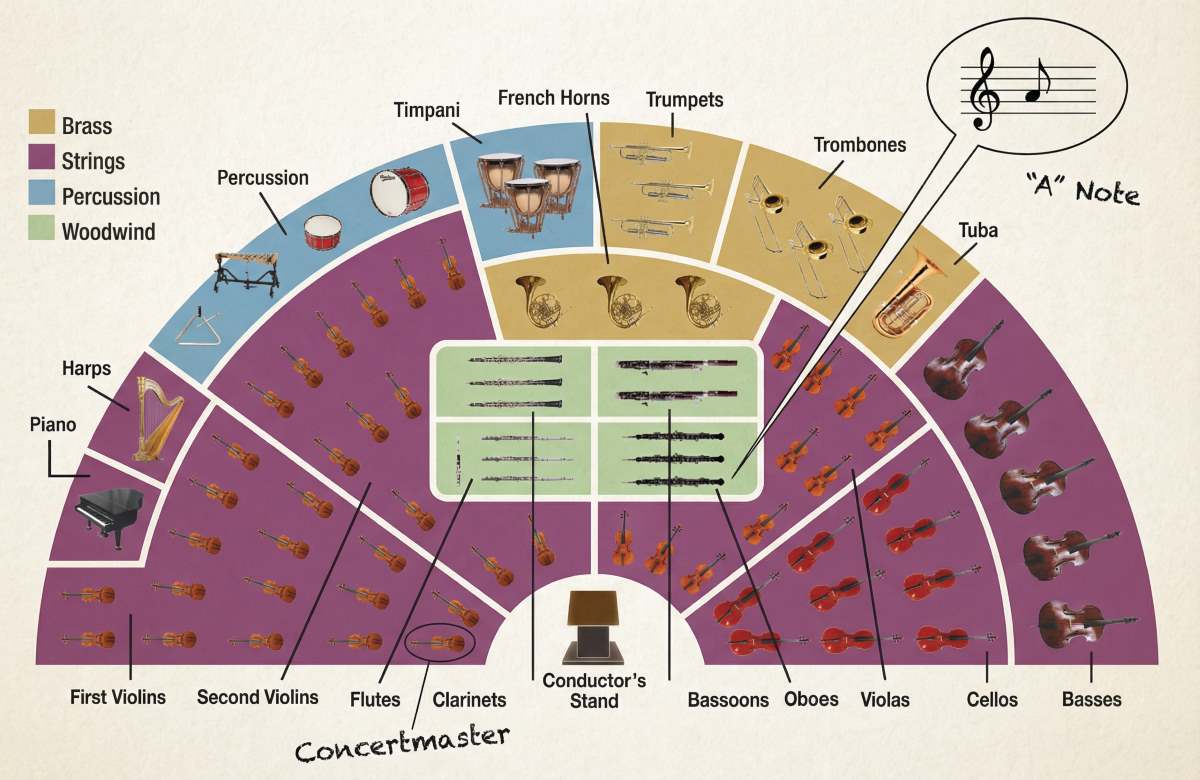
Understanding where each instrument sits in the orchestra — and where it sounds best — is fundamental to effective orchestration. Below you’ll find ranges, register characteristics, and listening examples for each orchestral family.
String Orchestration
The string section forms the foundation of the orchestra. From the brilliant E string of the violin to the rich depth of the double bass, strings offer the widest expressive range of any orchestral family.

- Violin: G3 to A7 — G string is dark and rich; E string is brilliant and penetrating
- Viola: C3 to E6 — Warm, noble, often described as “nasal” in character
- Cello: C2 to A5 — Combines bass depth with tenor singing quality
- Double Bass: E1 to G4 — Sounds an octave lower than written
String Orchestration Examples
- — the antiphonal writing and spatial depth is unmatched
- — technically flawless voicing, the definitive Romantic string orchestra work
- — the sheer range of what he gets out of the ensemble is extraordinary, from folk-tinged to terrifying
- — proof that strings alone can do absolutely everything, completely reinvented film scoring
Brass Orchestration
Brass instruments bring power and nobility to orchestral writing. Understanding balance is critical — Rimsky-Korsakov’s resonance equation: “1 Trumpet = 1 Trombone = 2 Horns” in forte passages.

- Horn in F: Soft, poetical, noble — serves as link between brass and woodwind
- Trumpet in Bb: Brilliant, heroic — sounds a major 2nd lower than written
- Trombone: Noble in chorale, powerful in climax — concert pitch
- Tuba: Foundation of brass section — avoid rapid passages
Brass Orchestration Examples
- — the brass chorales in the finale are the pinnacle of the form, that weight and patience is unmatched
- — twelve trumpets and completely unconventional, there’s nothing else like it in the repertoire
- — “The Great Gate of Kiev” shows you exactly how to build a brass climax that earns its power
- — the definitive modern fanfare, perfect balance of heroism and craft, and those French horn voicings are iconic
Woodwind Orchestration
Woodwinds provide colour and agility. Rimsky-Korsakov divided them into “bright” instruments (flutes, clarinets) and “dark/nasal” instruments (oboes, bassoons).

- Flute: C4 to D7 — Bright, silvery, excellent for rapid passages
- Oboe: Bb3 to G6 — Nasal, penetrating, best for expressive cantabile
- Clarinet: E3 to C7 (written) — Most flexible woodwind; chalumeau register is dark and rich
- Bassoon: Bb1 to Eb5 — Natural partner to horn; blends well with strings
Woodwind Orchestration Examples
- — that solo flute opening is probably the most famous woodwind moment in classical music, and the whole piece redefined what woodwinds could do expressively
- — the high bassoon solo that opens it was so radical people didn’t even recognise the instrument, and the rest pushes every woodwind to extremes
- — the cor anglais melody over sparse piano is heartbreaking, Ravel at his most perfect
- — paired bassoons, oboes, clarinets, flutes, trumpets in sequence, basically a textbook on woodwind character and colour
Ready to Explore the Orchestration Reference?
Open the interactive tool to browse all 38 instruments, view techniques and articulations, and discover which instruments blend best together.