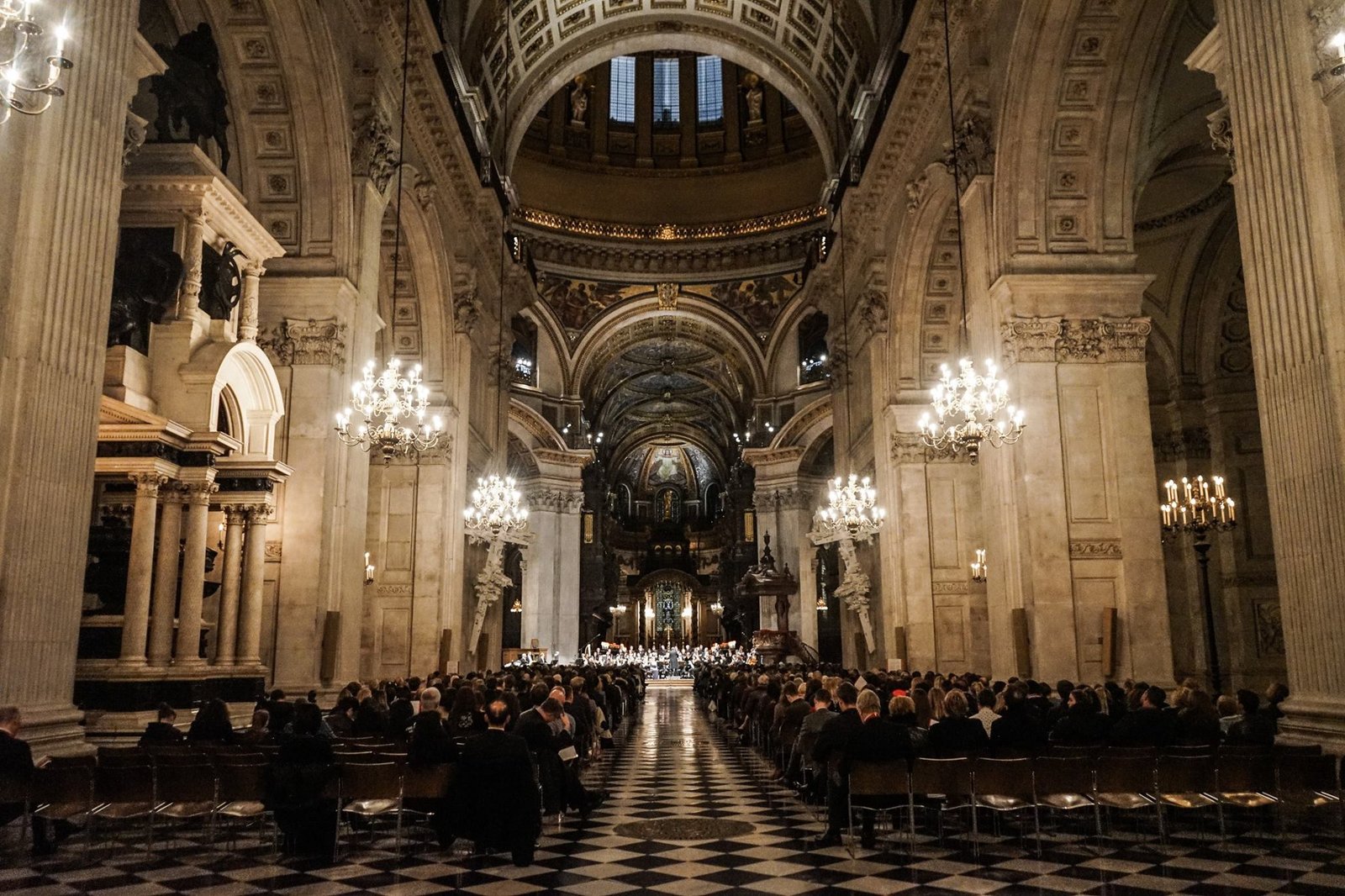
Orchestration Guide to the Instruments of the Orchestra
A free, interactive guide to the instruments of the orchestra: every orchestral instrument’s range on one chart, with pictures, registers, playing techniques and the combinations that blend, based on Rimsky-Korsakov’s Principles of Orchestration.
Explore 38 orchestral instruments with detailed register guides, bowing and articulation techniques, and practical tips on which instruments work best together. Free and interactive.
Open Orchestration Reference ToolWhat is orchestration in music?
Orchestration is the art of giving musical ideas to the instruments of the orchestra: deciding which instrument plays each line, in which register, and how the instruments combine for balance and colour. This guide shows the range, character and best registers of every orchestral instrument, so you can make those choices quickly.
Explore the Instruments of the Orchestra

Strings
The most expressive orchestral group. Capable of infinite shades from thundering fortissimo to barely perceptible pianissimo.

Woodwind
Diverse in colour and character. Bright instruments (flutes, clarinets) contrast with darker, nasal voices (oboes, bassoons).

Brass
The most powerful orchestral group. Heightens effect by sheer resonance, excellent for swelling from pianissimo to fortissimo.

Pitched Percussion
Instruments producing determinate sounds. Used for colour, punctuation, and sometimes melody. Timpani most important orchestrally.

Unpitched Percussion
Purely rhythmical and coloristic function. Use sparingly for maximum effect – triangle, snare drum, cymbals, bass drum, tam-tam.

Harp & Keyboard
Instruments of little sustaining power but distinct colour. Harp is primarily harmonic; piano and celesta add sparkle and clarity.
Why I Built This Tool
“Rimsky-Korsakov’s ‘Principles of Orchestration’ has sat on my piano since I was a student at the Royal Academy of Music. But physical books are awkward to reference mid-composition. I wanted something I could pull up instantly while working on a score.”
“This tool distils the practical wisdom from his 1913 masterwork into an interactive reference. Each instrument card shows you the range, register characteristics, and those golden tips that come from decades of orchestral experience.”
“Whether you’re scoring for film, opera and theatre, or choir with orchestra, I hope this helps you write more effectively for every instrument.”
About This Orchestration Guide
38 Instruments
Strings, woodwind, brass, percussion, harp & keyboard. Complete orchestral coverage with ranges and register characteristics for every instrument.
Techniques & Articulation
Bowing, tonguing, special effects for each instrument. Know what’s idiomatic and what to avoid before you write a note.
Blend Combinations
Which instruments pair well, doubling suggestions, and balance equations. Direct from Rimsky-Korsakov’s 1913 masterwork.
Orchestration for Beginners
Orchestration is the art of writing music for an orchestra, assigning instruments to different musical lines, and understanding how instrument combinations create different colours and effects.
If you’re new to orchestration, start by learning instrument ranges — knowing where each instrument can play, and more importantly, where it sounds best. Benjamin Britten’s “Young Person’s Guide to the Orchestra” is an excellent introduction to orchestral timbres, while this tool will help you understand the practical ranges for composition.
Common Mistakes to Avoid
- Strings + brass without woodwind — Each group is heard too distinctly. Add woodwind to bind the sound together.
- Overusing percussion — The effect becomes tiresome quickly. Use sparingly for maximum impact.
- Expecting horn agility — Horn responds slowly, not suited to rapid passages. Give fast lines to woodwind or strings.
- Close voicing in low register — Creates muddy, unclear harmony. Use wider spacing in bass, closer voicing higher up.
Source: Rimsky-Korsakov’s “Principles of Orchestration” (1913) — Public domain via Project Gutenberg.
Orchestra Instrument Ranges at a Glance
Understanding where each instrument sits in the orchestra — and where it sounds best — is fundamental to effective orchestration. Below you’ll find ranges, register characteristics, and listening examples for each orchestral family.
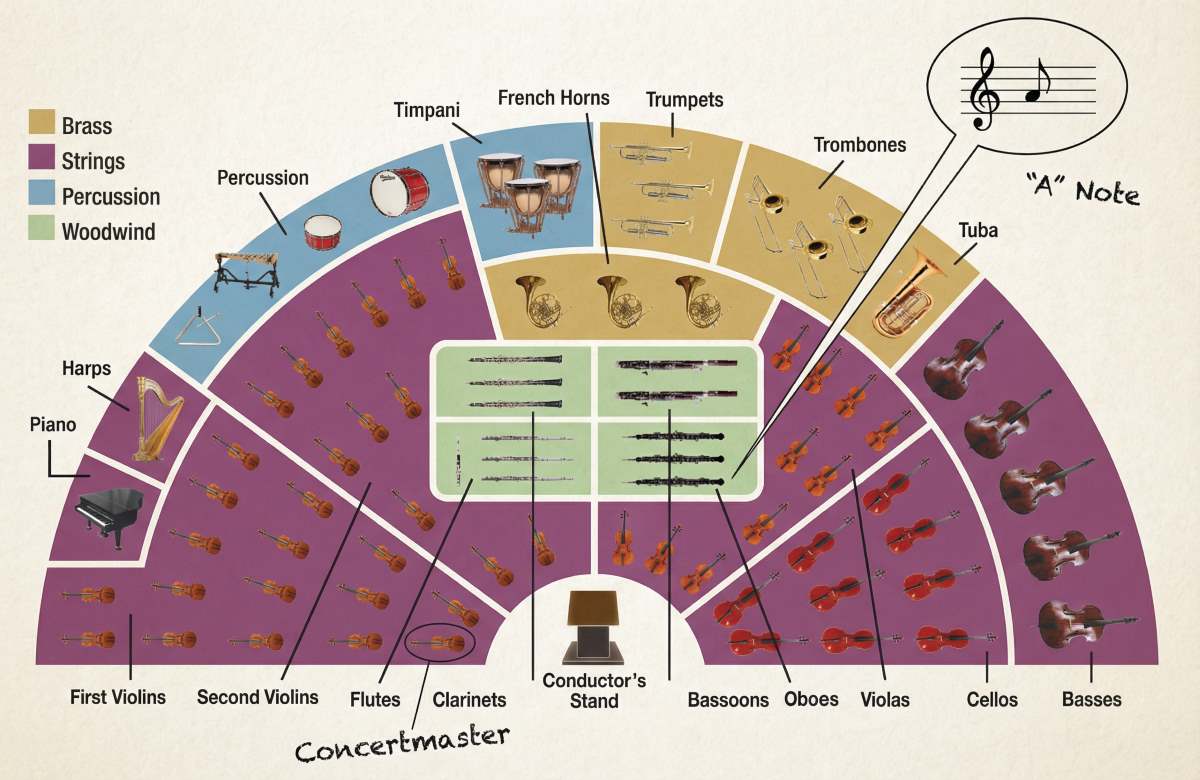
String Orchestration
The string section forms the foundation of the orchestra. From the brilliant E string of the violin to the rich depth of the double bass, strings offer the widest expressive range of any orchestral family.

- Violin: G3 to A7 — G string is dark and rich; E string is brilliant and penetrating
- Viola: C3 to E6 — Warm, noble, often described as “nasal” in character
- Cello: C2 to A5 — Combines bass depth with tenor singing quality
- Double Bass: E1 to G4 — Sounds an octave lower than written
String Orchestration Examples
- — the antiphonal writing and spatial depth is unmatched
- — technically flawless voicing, the definitive Romantic string orchestra work
- — the sheer range of what he gets out of the ensemble is extraordinary, from folk-tinged to terrifying
- — proof that strings alone can do absolutely everything, completely reinvented film scoring
Brass Orchestration
Brass instruments bring power and nobility to orchestral writing. Understanding balance is critical — Rimsky-Korsakov’s resonance equation: “1 Trumpet = 1 Trombone = 2 Horns” in forte passages.

- Horn in F: Soft, poetical, noble — serves as link between brass and woodwind
- Trumpet in Bb: Brilliant, heroic — sounds a major 2nd lower than written
- Trombone: Noble in chorale, powerful in climax — concert pitch
- Tuba: Foundation of brass section — avoid rapid passages
Brass Orchestration Examples
- — the brass chorales in the finale are the pinnacle of the form, that weight and patience is unmatched
- — twelve trumpets and completely unconventional, there’s nothing else like it in the repertoire
- — “The Great Gate of Kiev” shows you exactly how to build a brass climax that earns its power
- — the definitive modern fanfare, perfect balance of heroism and craft, and those French horn voicings are iconic
Woodwind Orchestration
Woodwinds provide colour and agility. Rimsky-Korsakov divided them into “bright” instruments (flutes, clarinets) and “dark/nasal” instruments (oboes, bassoons).

- Flute: C4 to D7 — Bright, silvery, excellent for rapid passages
- Oboe: Bb3 to G6 — Nasal, penetrating, best for expressive cantabile
- Clarinet: E3 to C7 (written) — Most flexible woodwind; chalumeau register is dark and rich
- Bassoon: Bb1 to Eb5 — Natural partner to horn; blends well with strings
Woodwind Orchestration Examples
- — that solo flute opening is probably the most famous woodwind moment in classical music, and the whole piece redefined what woodwinds could do expressively
- — the high bassoon solo that opens it was so radical people didn’t even recognise the instrument, and the rest pushes every woodwind to extremes
- — the cor anglais melody over sparse piano is heartbreaking, Ravel at his most perfect
- — paired bassoons, oboes, clarinets, flutes, trumpets in sequence, basically a textbook on woodwind character and colour
Famous Orchestral Solos for Every Instrument
The quickest way to learn an instrument’s sound is to hear it in music you already know. Here are two famous orchestral solos or passages for each instrument of the orchestra, from the oboe’s swan theme in Swan Lake to the tuba’s ox-cart in Pictures at an Exhibition. Press a title to listen.
Woodwind
- Piccolo: (III. Scherzo: Pizzicato ostinato); (Final trio)
- Flute: (Opening); (Dance of the Reed Flutes)
- Oboe: (Act II, No. 10 Scène (swan theme)); (II. Andantino in modo di canzona)
- Cor anglais (English horn): (II. Largo);
- E♭ clarinet: (V. Songe d'une nuit du sabbat); (Till's execution, near the end)
- Clarinet: (Opening); (III. Adagio)
- Bass clarinet: (Dance of the Sugar Plum Fairy); (I. Adagio – Allegro non troppo)
- Bassoon: (Introduction); (Main theme)
- Contrabassoon: (IV. Les entretiens de la Belle et de la Bête); (IV. Alla marcia)
Brass
- Horn: (II. Andante cantabile); (Opening)
- Trumpet: (I. Trauermarsch); (Promenade)
- Cornet: (Dance of the Ballerina); (The Birth of Kijé)
- Trombone: (Tuba mirum); (Trombone solo)
- Bass trombone: (Hungarian (Rákóczi) March)
- Tuba: (Bydło (The Ox-cart)); (V. Songe d'une nuit du sabbat)
Percussion
- Timpani: (Introduction (Sunrise)); (I. Opening)
- Glockenspiel: (Act I: 'Das klinget so herrlich'); (Main theme)
- Xylophone: (Middle section); (Fossils)
- Vibraphone: (I. Allegro); (Somewhere)
- Marimba: (I. Saudação)
- Tubular bells: (Finale); (V. Songe d'une nuit du sabbat)
- Crotales: (Closing bars); (Queen Mab Scherzo)
- Triangle: (III. Allegretto vivace); (III. Allegro giocoso)
- Castanets: (V. Fandango asturiano)
- Tambourine: (Trepak (Russian Dance)); (Opening)
- Snare drum: ; (Opening)
- Wood block: ;
- Cymbals: (IV. Finale); (IV. Allegro con fuoco)
- Suspended cymbal: (III. Dialogue du vent et de la mer)
- Bass drum: (Dies irae); (IV. Marche au supplice)
- Tam-tam: (IV. Finale: Adagio lamentoso); (Performance)
Harp and keyboards
- Harp: (Waltz of the Flowers); (II. Un bal)
- Celesta: (Dance of the Sugar Plum Fairy); (Neptune, the Mystic)
- Piano: (Russian Dance); (IV. Finale)
Strings
- Violin: (I. The Sea and Sinbad's Ship); (Opening)
- Viola: (I. Harold aux montagnes); (Theme: Sancho Panza)
- Cello: (Opening (dawn)); (The Swan)
- Double bass: (III. Feierlich und gemessen); (The Elephant)
Recordings play from YouTube’s privacy-enhanced player and belong to their channels. Each instrument page in the guide has the same pieces, plus a Philharmonia Orchestra film introducing the instrument.
Ready to Explore the Orchestration Guide?
Open the interactive tool to browse all 38 instruments, view techniques and articulations, and discover which instruments blend best together.
Photo credits
The instrument and family banner photos are from Wikimedia Commons. The images were resized to fit, centred on white and exported as JPEGs.
Strings
- Violin · Just plain Bill · Public domain · Source photo
- Viola · Just plain Bill · Public domain · Source photo
- Cello · Georg Feitscher (photograph), Unsubtlety (transparent cutout) · CC BY 3.0 · Source photo
- Double Bass · Andrew Kepert · CC BY-SA 3.0 · Source photo
Woodwind
- Clarinet · Yamaha Corporation (via Yamaha Music Europe) · CC BY-SA 4.0 · Source photo
- Piccolo · Yamaha Corporation (via Yamaha Music Europe) · CC BY-SA 4.0 · Source photo
- Flute · Yamaha Corporation (via Yamaha Music Europe) · CC BY-SA 4.0 · Source photo
- E♭ Clarinet · Yamaha Corporation (via Yamaha Music Europe) · CC BY-SA 4.0 · Source photo
- Bass Clarinet · Yamaha Corporation (via Yamaha Music Europe) · CC BY-SA 4.0 · Source photo
- Oboe · Yamaha Corporation (via Yamaha Music Europe) · CC BY-SA 4.0 · Source photo
- English Horn · Hustvedt and Arent · CC BY-SA 4.0 · Source photo
- Bassoon · Yamaha Corporation (via Yamaha Music Europe) · CC BY-SA 4.0 · Source photo
- Contrabassoon · Buffet Crampon · CC BY-SA 4.0 · Source photo
Brass
- Horn · Yamaha Corporation (photograph), Habitator terrae (background removal) · CC BY-SA 4.0 · Source photo
- Trumpet · Yamaha Corporation · CC BY-SA 4.0 · Source photo
- Cornet · Yamaha Corporation · CC BY-SA 4.0 · Source photo
- Trombone · Yamaha Corporation · CC BY-SA 4.0 · Source photo
- Bass Trombone · Yamaha Corporation · CC BY-SA 4.0 · Source photo
- Tuba · Yamaha Corporation · CC BY-SA 4.0 · Source photo
Pitched percussion
- Timpani · Moreau1 · Public domain · Source photo
- Glockenspiel · flamurai · Public domain · Source photo
- Xylophone · Gramorimba · CC BY-SA 4.0 · Source photo
- Vibraphone · Xylosmygame at English Wikipedia · CC BY-SA 3.0 · Source photo
- Marimba · Marimbaone · CC BY-SA 3.0 · Source photo
- Celesta · Schiedmayer Celesta GmbH · CC BY-SA 4.0 · Source photo
- Tubular Bells · Xylosmygame at English Wikipedia · CC BY-SA 3.0 · Source photo
- Crotales · Xylosmygame at English Wikipedia · CC BY-SA 3.0 · Source photo
Unpitched percussion
- Snare Drum · Unnecessary user · CC BY-SA 4.0 · Source photo
- Bass Drum · Žiga · CC0 · Source photo
- Cymbals · Andrew Alder (Andrewa) · CC BY-SA 3.0 · Source photo
- Suspended Cymbal · Andrew Alder · CC BY-SA 3.0 · Source photo
- Triangle · Unknown photographer · CC BY-SA 4.0 · Source photo
- Tambourine · Statens musikverk (Swedish Performing Arts Agency). Photographer: Olav Nyhus · CC BY-SA 4.0 · Source photo
- Tam-tam · Mojmir Churavy · CC0 · Source photo
- Wood Block · Ferbr1 · CC BY-SA 3.0 · Source photo
- Castanets · Rijksmuseum · CC0 · Source photo
Harp and piano
- Harp · The Metropolitan Museum of Art · CC0 1.0 · Source photo
- Piano · Photo: © Copyright Steinway & Sons · CC BY-SA 3.0 · Source photo
Family banners
- Strings banner · Just plain Bill · Public domain · Source photo
- Woodwind banner · Buffet Crampon · CC BY-SA 4.0 · Source photo
- Brass banner · Yamaha Corporation (photograph), Habitator terrae (background removal) · CC BY-SA 4.0 · Source photo
- Pitched percussion banner · Marimbaone · CC BY-SA 3.0 · Source photo
- Unpitched percussion banner · Andrew Alder (Andrewa) · CC BY-SA 3.0 · Source photo
- Harp and piano banner · The Metropolitan Museum of Art · CC0 1.0 · Source photo